 |  |
 |
|
||
 | ||
|
Press
C-Span came to record my book talk at Barnes and Noble last month, so I knew it was coming. But it was still exciting to flip the remote to C-Span in my parents' living room and watch them jump around at the sight of their kid on the TV set. The talk itself was good, but not as good as that feeling. As those of you who have purchased the book now, I dedicated it to my parents, who certainly have suffered the most from my love of questions. I don't think you can access the C-Span clip, but you can hear my latest interviews on The Peter B. Collins Show and Blog Business World with Wayne Hurlbert.
I had the great pleasure of being invited to Grit-TV to talk about the book. Laura asked me about why I wrote the book, whether the media is doing its job of asking questions, and about what kinds of questions I think people should be asking the answers to which cannot be Googled. The highlight for me was when they played clips from America's Town Hall Meeting on the Air, the old radio show that I argue is an illustration of how the media can model inquiry while engaging in current day debates. What a contrast to the Dobbs and O'Reilly of today. More in the chapter "Consuming Opinion." As Samuel Goldwyn once famously said, "When I want your opinion, I'll give it to you." I don't think Fox would disagree. What about the questions? Click here to watch. Clip is about 17 minutes long.
A review from Tom Watson, author of CauseWired (and friend): Every era has at least a few serious voices who openly question the new ways, the settled conventional wisdom around innovations in style, technology and social habits that change - at least on the surface - how society operates. As everybody else is celebrating the greatness of, well, themselves, these idoloclasts happily throw poison-tipped darts in a cultural clash with the totems of perceived progress. Such a counter-programmer is my friend Andrea Batista Schlesinger, the 32-year-old New Yorker and progressive activist whose first book The Death of Why holds up a big, fat stop sign to those who would celebrate under the banner "all that is modern is good." [Note: Andrea is the longtime executive director of the Drum Major Institute for Public Policy, a progressive think tank on whose board of directors I've served since 2002. She's on leave from that position while working as a policy adviser to the reelection campaign of New York City Mayor Michael Bloomberg.] The Death of Why goes against the grain. It stands opposed to any triumphalist viewpoints regarding digital communications. You can easily read it as the diametric opposite of Jeff Jarvis's somewhat hagiographic What Would Google Do?, for example. Andrea doesn't believe the Internet in general - and Google specifically - has necessarily made us any smarter or more democratic as a society. While she praises the innovation of always-available information and the worldwide networked conversation made possible by the network of networks, she also strikes out at the idea of searching as knowledge, of linking as journalism or education. And she uses one particular commentator's voice as a stalking horse for her arguments against the Internet-as-knowledge: mine. In the fourth chapter - In Google We Trust - Andrea posits that the "Internet responds to curiosity as much as it creates it" but argues that "searching for answers" isn't the same thing as answering questions. Then she quotes me: "Certainly we're in far better shape, in terms of tools and ability, for deep inquiry than we used to be." Not so fast, argues Andrea. "When I survey the search engine landscape, I see conditions that are less than inspiring of 'deep inquiry' especially for our youngest. I see the formation of habits of mind characterized by a dangerous lack of discernment." And young people, she says, bounce around as guileless link and search-box addicts, mistaking the search-cut-paste process for deep inquiry. This is undoubtedly true in many instances. I've seen it. But I'm not sure it's a bigger problem than the use of Cliff Notes or the Xerox machine by earlier generations. In the end, I'm not sure young Americans really are less inquisitive. That may be because of the field I've worked in for the last decade - progressive causes and philanthropy - tends to attract young, enthusiastic professionals who won't take no for an answer and seem to question everything. Then too, the social entrepreneurs I profiled in my book CauseWired: Plugging In, Getting Involved, Changing the World were similarly driven to challenge every status quo they found - and to use digital technology to do so. Finally, my own three children are constantly questioning things that I tend to think of as settled subject matter, with no hesitation to challenge and probe and looks things up. They don't necessarily follow the leader. Nonetheless, The Death of Why is an important book - and I think it's particularly timely, given the challenges that major American institutions (like big newspapers and Federal agencies) are facing in an increasingly crowd-sourced era. It's a great book for journalists concerned that the so-called "link economy" leaves serious inquiry out in the cold - and for e-government types who seek to go beyond merely making information available in vast databases but to actually encourage citizen involvement in our republic. And this goes for newspapers, whose approaching demise the author mourns loudly. Currying no favor with the digerati, Andrea argues (and I agree) that the decline of news organizations is bad for democracy and that it's unlikely that blogs and online specialty sites will rise to replace the full gamut of professional journalism. "When you start the day with the newspaper," she writes, " you start with the recognition that you are a person in the world, with a need and responsibility to engage." Throughout the book, Andrea decries the echo chamber of modern information and communications - the trend toward finding what you want (the viewpoint you already support) rather than coming across something you didn't know. That "self-segregation" does indeed permeate much of what we take as political dialogue for instance. Andrea decries the national political process in the modern age, panning the 2008 Presidential debates between Senators Obama and McCain as flimsy and personality-driven, and slyly pointing out that Hillary Clinton's campaign was rejuvenated when she came out of the bubble and started taking tough, unscripted questions. "The irony is that the candidates need not fear questioning," she says. Perhaps the best quality of The Death of Why lies in its inherent skepticism toward what we've come to accept as the right way to approach learning, particularly public education. Andrea's a bit young for curmudgeon status, but her gruff and skeptical take on so-called "financial literacy" is welcome. So much of this kind of education is really marketing, priming the sales pump for future consumers. And if that passes for inquiry, we're in serious trouble. Writes Andrea: "Our democracy will suffer if the youngest among us grow up thinking that today's society and the economy that sustains it are working just as they should." Click here to continue the conversation
Robert Ellman of the Intrepid Liberal Journal grills me in this podcast interview currently cross-posted throughout the political blogosphere. Click here to listen. From Rob's intro: "The one life lesson Schlesinger has learned above all others in her career and promotes passionately her book is that questions equals power. It is Schlesinger's contention that our culture promotes instant answers at the expense of inquiring. With this book, Schlesinger has four primary objectives: 1) Convince readers of the importance of inquiry in our democracy; 2) Illustrate how the very institutions that should be encouraging inquiry such as schools, the media, and government, the Internet are instead undermining intellectual curiosity in our society; 3) Inspire readers with hopeful examples of people working to restore inquiry to its rightful place of importance; 4) Convey a sense of urgency among citizens to develop effective "habits of the mind" and not be easily seduced by instant easy sound bite answers to complex challenges such as global warming. Death of Why, is a well researched and scrupulously sourced eleven chapters and 215 pages of text. Where Schlesinger's book is especially provocative is when she takes bloggers like me to task for engaging in robotic group-think and avoiding engagement with people possessing different viewpoints." Thanks, Rob, for the great interview.
I had a great time participating in the Firedoglake book salon yesterday. The conversation was moderated by Mark Bauerlein, author of The Dumbest Generation. His generous and thoughtful intro:
This is not to say that questions don't happen and media don't expose the workings of power. Those things circulate all the time, but they get lost in the flood of information and 24/7 news cycles. Furthermore, other forces squelch young people's curiosity about such matters. They include: * Parenting styles that emphasize self-esteem and praise, with the effect of discouraging the kind of intellectual struggles that come with civic inquiry. It's a consumerist, individualist era, Schlesinger maintains, and people eschew the labor of examination. "I see an environment that prizes projections of certainty over the wisdom gained from questioning, and questioning again," she says (page 5). Whereas the Internet, politicians, and media promise a world ever-more respectful of public opinion, audience tastes, and empowered users, in truth, "I see us asking our media, our politicians, our self-help gurus for an answer, any answer, to help us understand the world around us." Indeed, therein lies the real attraction of the Internet--not that it opens people to the world and inspires their curiosity, but that it delivers quick and handy resolutions to their confusions and uncertainties. Schlesinger sprinkles illustrations in the commentary to flesh out the message. An appearance with Lou Dobbs on CNN to discuss immigration, a conservative commentator writing about social justice education, local politicians in Hampton, VA, contending with young activists, and advocates of financial literacy in the classroom . . . they display the momentum of an anti-inquiry society. For instance, while civics knowledge among young people is abysmal (only one in four high school seniors on the 2006 NAEP exam reached "proficiency"), politicians and private organizations involved in education such as Jump$tart are more interested in courses in "Money 101" than in "Government 101." And while advocates of digital learning such as Tom Watson claim that "the Internet encourages curiosity," Schlesinger finds that "young people search for information online without any intention. They bounce all over the place, hopping and skipping their way through content" (page 61). The Bush Administration pledged that No Child Left Behind would raise outcomes across the board, but their testing focus, though it may have enhanced basic skills, blunted civic knowledge and critical thinking. These tendencies jeopardize the body politic, Schlesinger concludes, and its reversal begins precisely with a rededication to a vigilant, informed citizenry that guards its prerogatives closely, but doesn't lapse into a self-involved, my-opinion-is-as-good-as-your-opinion mindset. We need a more intelligent, querulous civic sphere, and we waste our time waiting for politicians and media to deliver it. Click here to read the discussion.
FDL Book Salon Welcomes Andrea Batista Schlesinger: The Death of Why? Andrea Batista Schlesinger's commentary has a simple thesis. An inquisitive attitude is essential to dutiful citizenship in a democracy, and the attitude is waning among American youths. Teenagers and 20-year-olds in the United States have little curiosity about the workings of government, they don't follow the actions of their representatives, they don't read the newspaper or watch the network news, and, worst of all, they don't care--or at least they are taught not to. The institutions that should inspire civic inquiry--schools, media, governments--fail their responsibility, sometimes deliberately so, and the rising generation follows their lead. We've lost the crucial interrogative "Why?" This is not to say that questions don't happen and media don't expose the workings of power. Those things circulate all the time, but they get lost in the flood of information and 24/7 news cycles. Furthermore, other forces squelch young people's curiosity about such matters. They include: * Parenting styles that emphasize self-esteem and praise, with the effect of discouraging the kind of intellectual struggles that come with civic inquiry. It's a consumerist, individualist era, Schlesinger maintains, and people eschew the labor of examination. "I see an environment that prizes projections of certainty over the wisdom gained from questioning, and questioning again," she says (page 5). Whereas the Internet, politicians, and media promise a world ever-more respectful of public opinion, audience tastes, and empowered users, in truth, "I see us asking our media, our politicians, our self-help gurus for an answer, any answer, to help us understand the world around us." Indeed, therein lies the real attraction of the Internet--not that it opens people to the world and inspires their curiosity, but that it delivers quick and handy resolutions to their confusions and uncertainties. Schlesinger sprinkles illustrations in the commentary to flesh out the message. An appearance with Lou Dobbs on CNN to discuss immigration, a conservative commentator writing about social justice education, local politicians in Hampton, VA, contending with young activists, and advocates of financial literacy in the classroom . . . they display the momentum of an anti-inquiry society. For instance, while civics knowledge among young people is abysmal (only one in four high school seniors on the 2006 NAEP exam reached "proficiency"), politicians and private organizations involved in education such as Jump$tart are more interested in courses in "Money 101" than in "Government 101." And while advocates of digital learning such as Tom Watson claim that "the Internet encourages curiosity," Schlesinger finds that "young people search for information online without any intention. They bounce all over the place, hopping and skipping their way through content" (page 61). The Bush Administration pledged that No Child Left Behind would raise outcomes across the board, but their testing focus, though it may have enhanced basic skills, blunted civic knowledge and critical thinking. These tendencies jeopardize the body politic, Schlesinger concludes, and its reversal begins precisely with a rededication to a vigilant, informed citizenry that guards its prerogatives closely, but doesn't lapse into a self-involved, my-opinion-is-as-good-as-your-opinion mindset. We need a more intelligent, querulous civic sphere, and we waste our time waiting for politicians and media to deliver it. Click here to read the conversation including comments and questions from members of the Firedoglake.com community.
Lots of life for "The Death of Why." Today, the "Ideological Segregation by Click and by Clique" chapter is excerpted at Alternet.com where a lively discussion in the comments section is underway. On Saturday, you'll find me on Firedoglake.com's book salon for a two-hour chat moderated by Mark Bauerlein, author of The Dumbest Generation. We don't agree on everything, so this should be an interesting conversation. On Monday, I'll be in DC at Busboys and Poets to talk with Deepak Bhargava of the Center for Community Change about the book and its relevance to the progressive movement. Lots more in the events section. Check it out, sign up, and don't forget to buy a copy...
"The Death of Why" excerpted on Alternet.org Provocative New Book Challenges Us to Really Ask "Why?" Ideological Segregation by Click and by Clique Click here for more and to participate in the conversation.
The Death of Why in Los Angeles Times Answers can be found in questions With apologies to Nike, if the United States were a for-profit venture, its slogan would be "Just do it." Few would dispute the notion that we are an action-oriented people. From an early age, Americans are bombarded with the message that actions speak louder than words and that talk is cheap. Who among us as a child opening presents on his birthday really believed the moral that it's the thought that counts? Come on! To the extent that we do value thinking, it's usually as a means to action. We're taught to want solutions, find answers, get to the bottom of things. We pride ourselves in our pragmatism. As Ralph Waldo Emerson once put it, "Nothing astonishes men so much as common sense and plain dealing." That's so American. OK, I'm not about to repeat the hackneyed liberal charge that we are a nation of unthinking dolts, or H.L. Mencken's famous dictum about "the booboisie." I think our orientation toward action has a lot to do with the fact that our country was founded on and built around some rather lofty ideas: freedom, equality, liberty. You can envision U.S. history as the constant uphill battle of trying to turn those ideas into reality. In the beginning, there were ideas. They demanded action. The reality is, we don't see a big dichotomy between action and knowledge. Knowledge gets us where we want to go. In fact, now more than ever, Americans seem to have a grasp of this fact or the other. Having flattened the world of news and knowledge, the younger generations in particular have trillions of facts at their fingertips. "Search" has made us all drive-by scholars. This, according to liberal think-tanker Andrea Batista Schlesinger, has only heightened our collective "obsession with answers." The problem, she says, is that we're less and less likely to be engaged in the questions. Quick access to facts has made us too impatient to engage in lengthy deliberation, "deep inquiry" or discernment. In her new book, "The Death of Why?," Batista Schlesinger -- until recently, the executive director of the Drum Major Institute for Public Policy in New York -- makes a passionate case for inquiry qua inquiry. She links the future of the American experiment to the extent to which we teach our children how to ask questions. Even as society more and more limits its definition of civic engagement to results-oriented activism, Batista Schlesinger defines it as teaching Americans to discuss problems and giving them the intellectual skills to navigate our democracy. For example, she acknowledges the uptick in youth political involvement in the Obama era -- they voted, gave money, sent e-mails. She nonetheless questions young people's depth of engagement in the political process. She suggests that it's not enough to mobilize people to advocate for this or that position. What's more important is cultivating long-term, patient "skills of inquiry, problem solving and creative thinking." As Batista Schlesinger puts it, "We have the mistaken belief that even the most pressing challenges facing our country -- climate change, globalization, healthcare, poverty -- are problems to be 'fixed' once and for all, if only we can find the right solution and the right person to implement." This overwhelming preference for outcome over process is part of what has led to the ideological polarization of the country. The desire for certainty -- hard facts, quick answers -- in an uncertain world leads people to take refuge in political or religious ideology. Ideological solutions -- whether from the left or the right -- generally offer us simple answers to complex problems. In a way, Batista Schlesinger is asking us to take a step back from politics in order to gain newfound respect for the political process. She advocates for what she calls "slow democracy." She's also asking us for a little humility and to embrace a healthy dose of doubt. Our salvation lies in our willingness to rethink the world in its ever-changing configurations. "What we need to acknowledge, now more than ever," she writes, "is that we do not know everything. We cannot know everything. Knowledge changes. ... The future is a moving target, and the ground beneath us will never be still. The only thing we can count on to see us through an uncertain future is our ability to ask questions."
Today I participated in a book chat at Crooks and Liars. The questions were fantastic, but hard. I hope it's a sign of how the theme resonates with people. Here's the chat, starting with an intro post from the fantastic Nicole Belle: C&L Book Chat: The Death of Why by Andrea Batista Schlesinger
Just a simple one-word sentence, yet it conveys probably the most anarchic, the most radical, the most provocative and the most democratizing thought in the world. The ability to question....no, the right and responsibility to question is the very cornerstone of our democracy. The Founding Fathers set forth programs and laid the groundwork to check the workings of our govenment by requiring it to answer to the people from which it was composed. And yet, somewhere in the last forty years ago or so, we've lost our way. We, collectively as a nation, have decided that we needed to focus on the answers rather than ask the questions. We opt to live among others who share our values, rather than stand to have them questioned by other points of views. We select our media sources from those with which we share an ideological point of view, so our preconceived biases never are challenged. We pour money into the self-help industry, looking for someone to give us the answers that we seek, rather than do the hard work of finding our own path or questioning if we need measure our success in the same way. We gravitate towards politicians who appear to us to have the answers, even though the issues that face us cannot be "solved" by simple answers. Our lack of appreciation of the power and value of questions leave us mostly disengaged from the democracy of which we're a part. Fewer and fewer people have any notion of how government works and that lack of engagement enables life-changing legislation to get passed with little public discussion. Where did we lose our way? When did questioning stop being an act of democracy and become unpatriotic? How does this bode for our collective future as another generation is raised with fewer skills to look deeper at issues and analyze and synthesize information to consider solutions? Drum Major Institute's Executive Director Andrea Batista Schlessinger looks at this issue in her new book The Death of Why and she joins us here today to discuss it. It is Andrea's position that so much of the policy debate is won in the framing. How are issues discussed? Through what lens do we approach debates about government and its role in our lives? Are we creating the capacity/will/desire in our young people to question? Are the tools that we give children to learn actually limiting their ability to really think? These are questions that go right to the heart of where we find ourselves today and some fairly frightening prospects for our future if we don't reintroduce the value of questioning to the next generation. Please welcome Andrea Batista Schlessinger to C&L and let's discuss The Death of Why: Click here to read the discussion.
I was very excited to be asked to contribute an essay to the AFL-CIO's Point of View Project on a topic related to the book. Here it is. Please let me know what you think! And check out the other essays - very interesting stuff. I especially enjoyed this piece on Francis Perkins: Remember Civics? Here's Why We Need It We all have to start caring a lot more about civics. Civics? Yes. If we want to ensure that a pro-worker progressive movement is in our future, we need to raise a generation of young people who feel connected to the institutions of their democracy, who understand how to navigate them and who understand from an early age that it is their right--and their responsibility--to question them. In 1906, the Committee of Five, appointed by the American Political Science Assocation to examine the extent to which schools were preparing high school students for citizenship, "linked poor preparation at the early levels to the plethora of bad politicians and weak public servants its members believed dominated turn-of-the century American government." According to Prof. Hindy Lauer Schachter, who authored a study on these early effects, the success of our participatory democracy was viewed as directly related to the preparation of its youngest citizens. If you believe that this is true today, then you must also worry that our democracy is in sorry shape. Since 1969, the federal government has tested young people on their civic knowledge -- that is, their understanding of the inner workings of government and their rights and responsibilities as citizens. These exams are part of a larger battery of tests in all subjects, called the National Assessment of Education Progress (NAEP). Unlike the other exams, however, NAEP civics is tested only every four years. By comparison, math and reading are tested at least every two years, as required by No Child Left Behind. According to the 2006 NAEP Report Card, only one in four American twelfth graders was found to be "proficient" (and this was not a high bar). Five percent of twelfth graders tested could explain three ways in which the president can be checked by the legislative or judicial branches. One in two could explain the outcome when state and national laws conflict. Twenty-eight percent of eighth graders could articulate the historical purpose of the Declaration of Independence. When presented with a photograph of the 1963 March on Washington with Martin Luther King, only one in four could explain "two specific ways in which marches and demonstrations such as the one illustrated can achieve political goals." Lack of civil knowledge on the part of our young people, as evidenced by these scores, is a long-term threat. The decision to vote--and then the basis upon which people make their decisions in the voting booth--can be traced to our civic knowledge. According to Samuel Popkin and Michael Dimock, political scientists and authors of "Knowledge and Citizen Competence": "Nonvoting results from a lack of knowledge about what government is doing and where parties and candidates stand, not from a knowledgeable rejection of government or parties or a lack of trust in government." But more than just knowing stuff, and more than just knowing how to vote and wanting to, it is important that young people have the experience of getting their hands dirty, talking about current events as they unfold and learning how government works through first-hand experience. When civics was more important in the schools in the 20th century, for example, children brought home civics grades on their report cards. In fact, students took three civics classes, including Problems in Democracy, in which they talked about current affairs and challenges facing American government. "We know that a substantial percentage of kids in the mid-20th century took that Problems in Democracy course," lamented Peter Levine, director of the Center for Information & Research on Civic Learning and Engagement. Today, that course is gone, with nothing to replace it. "I really do think that [coursework] probably can't be found in the intricacies of today's curriculum," Levine told me. "It's not like they're doing that somewhere else." And why not resuscitate this course? Because it doesn't fit in to the goals of No Child Left Behind? Well, reconcile that with the data showing that students who talk about current events with their families are more likely to be engaged citizens and that engaged citizens who participate in civic activities are better students. Today, there are some efforts working to help young people learn how to navigate their local institutions. Like Project Citizen. In the words of its founder, Charles Quigley, Project Citizen "actively engages kids in going into their communities, interviewing people, doing survey research, identifying public policy problems, developing their own proposed solutions and political action plans, and trying to have an impact on City Hall." Unfortunately, the program reaches only about 500,000 students each year--1 percent of the nation's 2006 school-age population. (Though I suppose we should be satisfied that the program survived the Bush administration's efforts to decimate it--given how Bush officials can't have been too keen on preparing children to question and change their government.) Maybe it's anachronistic, but I think we need to raise young people who care about their local institutions as much as they do the worlds they can access through Facebook, who have an understanding about how to pursue policy change right there in their local City Hall, who talk about current events and who know what a march on Washington can accomplish. I care about civics because I care about a lasting progressive agenda in our country, one that is based on the right and ability of regular people to influence the direction of their government.
Two years ago, I began the journey of writing this book. A lot has changed in that time - both in the real world and in my own life - but one thing remains as clear to me as when I began writing my book proposal: the question we ask is as the important as the answer. It is with the question that we define the parameters of the conversation. It's true when it comes to our personal lives -how many times have we fought with the people around us only to realize that we were answering different questions? It's especially true when it comes to public policy. Look at the national debate over education reform. I write about this in Part 2 of my book, entitled "Citizens or Consumers?" I write about the decline of value placed on civics education in our schools, where young people are taught to question their democracy. I contrast that with the growing movement for financial literacy in the schools, where I believe young people are taught to navigate the market as is. And, of course, this is all happening at the same as standardized testing and "accountability" have come to define the educational experience of children throughout the country. What better evidence of the prioritization of answering rather than questioning? In all of the conversation about the direction of our schools, experts, policymakers, advocates, etc. each offer their own perspective on what is most important and what works and what doesn't in a conversation that seems to operate at such cross-currents that I wonder if they are even answering the same question. And I offer that the real question that they should be asking is: What is the role of the public schools? Is it to prepare citizens? To prepare consumers and workers? I argue in the book that the answer to this question will lead us in very different directions when it comes to education policy. If we aim to prepare workers and consumers, it makes sense to emphasize standardized testing and to use valuable school hours to prepare children to manage their finances. If we believe, as the founders of the public school system did, that our schools should prepare citizens, we will have a different definition of success and therefore a different approach to what children experience each day. I just doubt that, the personal vision and commitment of those engaged in the education debate notwithstanding, we can have a meaningful conversation about what to do with our schools if we don't ask the deeper questions about the role public education should play in our lives. There is no one "reform" that can trend this requirement. In fact, there can be no real and lasting reform without a conversation that starts with that question. More on that over the next few days. Of course, get the book for the background. What are you questioning today?
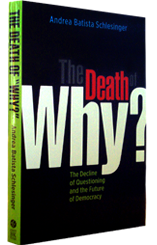
Who Killed the Why? Andrea Batista Schlesinger, a featured speaker at Facing Race 2008 and an ARC boardmember, has written her first book, The Death of Why: The Decline of Questioning and the Future of Democracy. The ability to inquire deeply is the lifeblood of a great democracy, Andrea argues, and Americans have lost much of their questioning muscle in the age of the internet and standardized testing. In chapters ranging from disappearing civics education to the myth of financial literacy ("No Piggybank Left Behind!"), Andrea teaches us the value of struggling with what we don't know, so that we can think and act in ways that transport us outside of our conventional bubbles of so-called wisdom. The book is full of stories, both cautionary and inspiring. Since Andrea blames me for coming up with the miserable notion that she should write a book, good sales among ARC friends will help heal our relationship.
TPMCafe Book Club Colorado: Heads Up! Radio 88.5 FM (Boulder) / 1390 AM (Denver) Wisconsin: The Alan Eisenberg Show at WRJN 1400 AM Boston: Harvard Square Coop Event Providence: Brown University Bookstore
Houston: Interview with Wally James of the "The Progressive Forum" on Pacifica radio Blog Talk Radio - Blog Business World with Wayne Hurlbert Podcast interview on The Peter B. Collins Show NYC: Barnes and Noble reading Santa Fe: Public Radio Interview on KFSR "Journey Home" with Diego Mulligan GritTV with Laura Flanders DC: Reading at Busboys and Poets bookstore. The Morning Show on KPFA July 10, 2009 Click here to listen New York City book release party Crooks & Liars book chat
|
||
 |
||